Tradeweb Government Bond Update – November 2025
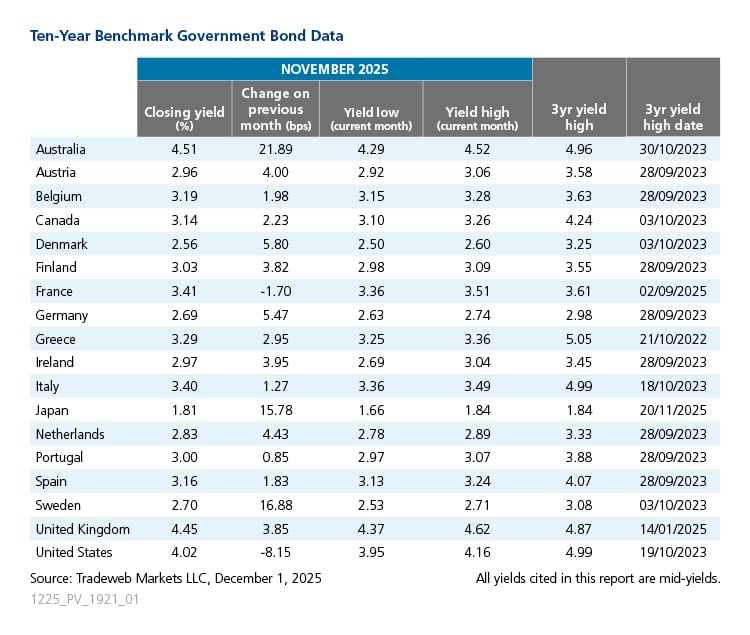
In a reversal of October’s trend, global 10-year government bond yields increased in November, except those for France and the U.S., which fell by two and eight basis points, respectively.
Japan’s 10-year government bond yield reached a 17-year high of 1.84% on November 20, before ending the month slightly lower at 1.81%. The country’s annual inflation rate edged up to 3% in October from 2.9% in September, the highest reading since July this year.
Taichi Shibuya, Head of Japan at Tradeweb, said: “Japanese government bond yields continued to push higher in November. Those on 10-year debt rose 16 basis points during the month, as investors reassessed the Bank of Japan’s policy path and the government’s fiscal policy. While yields eased slightly into month-end, the upward move underscores the market’s sensitivity to shifts in policy expectations and broader global rate dynamics.”
However, the month’s biggest mover was the yield on the Australian 10-year bond, which climbed nearly 22 basis points to 4.51%. On November 4, the Reserve Bank of Australia (RBA) kept its cash rate unchanged at 3.6%, maintaining borrowing costs at their lowest level since April 2023. The country’s annual inflation rose to 3.8% in October from 3.6% in the prior month, remaining above the RBA’s 2–3% target.
In the U.S., the yield on the 10-year Treasury benchmark note closed the month at 4.02%. The prolonged government shutdown meant that few major economic indicators were released, leaving a noticeable gap in the month’s data flow and fewer signals for investors to gauge the economy’s near-term trajectory.
Over in Europe, the UK 10-year Gilt yield increased just four basis points during the month to 4.45%. The country’s annual inflation rate eased to 3.6% in October, the lowest level in four months, while the S&P Global UK Manufacturing PMI rose to 50.2 in November from 49.7 in the prior month, pointing to a modest improvement in activity. In contrast, the GfK Consumer Confidence Index fell to -19 in November from -17, as households braced for Chancellor Rachel Reeves’ Autumn Budget, which included freezes to income-tax thresholds and new levies on property, dividends and electric vehicles, alongside higher welfare spending and public investment.
In Germany, the 10-year Bund yield climbed five basis points to 2.69% at month-end. According to preliminary estimates, the country’s annual inflation rate remained unchanged at 2.3% in November. Meanwhile, the HCOB Germany Manufacturing PMI dropped to 48.2 from 49.6 in October, amid ongoing customer uncertainty and weaker overseas demand.
In neighbouring France, political turbulence persisted through November as the budget standoff deepened. The government under Sébastien Lecornu, himself only recently re-appointed as Prime Minister, put pressure on lawmakers to pass the 2026 budget by year-end, after the lower house rejected the tax side of the legislation. The French 10-year government bond yield ended the month at 3.41%, and its annual inflation rate held steady at 0.9%, unchanged from October and below the 1% forecast, according to preliminary estimates.
Related Content