Tradeweb Government Bond Update – June 2026
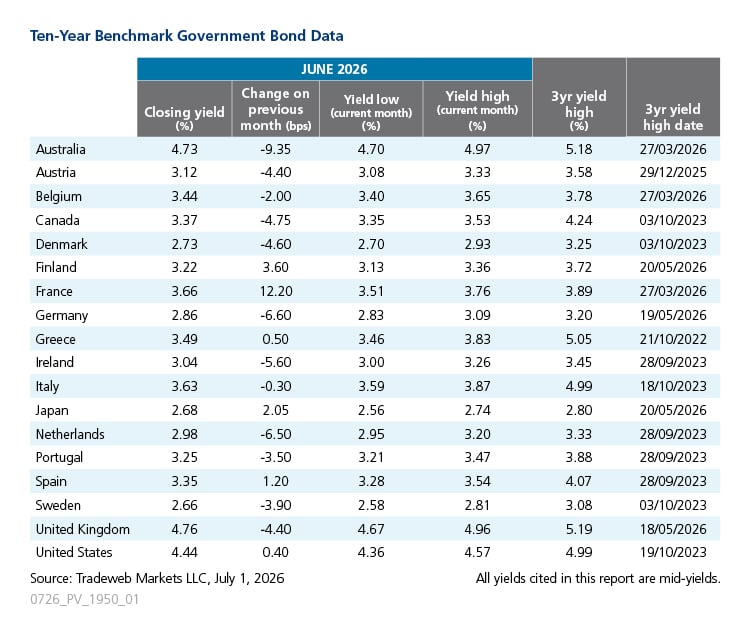
Government bond markets were relatively subdued in June following heightened volatility in May. Most major 10-year benchmark government bond yields recorded modest moves as investors digested central bank decisions and incoming economic data. France saw the largest shift, with its 10-year government bond yield rising over 12 basis points to end the month at 3.66%.
At its June meeting, the European Central Bank (ECB) raised its three key interest rates by 25 basis points, citing renewed inflationary pressures driven by higher energy prices and increased geopolitical uncertainty. The ECB also revised its inflation forecasts higher while lowering its outlook for economic growth. The yield on Germany's 10-year government bond declined by 6.6 basis points to 2.86%, while its Italian counterpart edged slightly lower from its May close to 3.63%.
The UK 10-year gilt yield also fell by 4.4 basis points to end the month at 4.76%, as markets continued to assess the outlook for inflation and monetary policy. The Bank of England left rates unchanged at 3.75% by a 7–2 vote on June 18, and stressed it "stands ready to act as necessary" to ensure inflation returns sustainably to its 2% target.
Australia’s 10-year benchmark bond yield dropped by 9.4 basis points to 4.73% on June 30. Following three consecutive 25-basis-point rate hikes earlier in the year, the country’s central bank left its cash rate unchanged at 4.35%, but noted a rise may be justified in months ahead. Manufacturing and services PMIs, as well as the flash composite PMI for Australia, highlighted continued pressures on output and prices.
Meha Thind, Head of Asia (ex-Japan) Swaps at Tradeweb, said: “Markets are reassessing the path of policy rates in an environment where further easing is far from assured. While central banks may want to cut interest rates, they may not yet be in a position to do so, as they continue to watch the data and inflation risks closely.”
The Japanese 10-year government bond yield rose 2 basis points to 2.68% during June. The Bank of Japan raised its policy rate by 25 basis points to 1%, its highest level since 1995. Policymakers cited mounting inflation risks stemming from higher energy costs and the weak yen, while signalling that the gradual normalisation of monetary policy will continue if underlying inflation remains on track.
Meanwhile, the U.S. 10-year Treasury yield was little changed from May, finishing June at 4.44%. The Federal Reserve held interest rates and Kevin Warsh presided over his first meeting as the new chair, announcing multiple committees to provide advice on potential changes to practices like forward guidance. Economic data released during the month pointed to resilient business activity and a still-solid labour market, supporting expectations that the Fed will remain patient before making further policy adjustments.
Related Content